

ChromeCarbon: Guilt-Free, Climate-Positive Motoring

The fact that new petrol-powered cars will no longer be available sometime in the near future is nothing but a bit of a nightmare. The way a car sounds and behaves as the engine climbs up revs is instrumental in making one fall in love with driving. And while battery-powered vehicles will take care of catering to a large percentage of customers’ needs — with supreme acceleration and an impressive ability to be updated over the air —it might take a while for keen car lovers to accept those as anything more than appliances. The biggest draw in the favour of electric and even hybrid vehicles is the prospect of driving something with zero-emissions (from the exhaust) and incomparable efficiency. But for car lovers, the question arises: how do we ensure that we can run our favourite petrol-powered cars (or even diesels, if that’s what you prefer) for longer without further harming the environment? ChromeCarbon might have an answer to that.
Before delving into what ChromeCarbon is, and before wondering how they’ve found a solution to an issue that remains unsolved by carmakers, let us get a few things cleared. First, no car is made without creating a negative impact on the environment. From the mining of materials to actual manufacturing/assembly of the car, everything will have an impact. And then there’s the procurement of fuel. Getting petrol isn’t a zero-emissions process, and the same is true about the production of electricity, which, in a lot of countries, still comes from non-renewable sources.
Now, the idea is to keep the impact on the environment as low as possible. And the best way to do that is by replenishing nature as much as we can. It’s simple, and ChromeCarbon does exactly that.
How? The company has ongoing projects under the banners Carbon Reduction and Reforestation. The former is a group of initiatives through which we can reduce our dependency on conventional sources of energy, and this is how ChromeCarbon offsets using Verified Emission Reductions. On the other hand, the latter is about planting more trees in various parts of the world for a long-term environmental benefit. The reforestation is done in the United Kingdom, Europe, North America, Latin America, Africa, and Asia & Australia. That sounds like any other environmental charity, so how does it differ, you must wonder. The main difference here is that ChromeCarbon is clearly run by someone who loves cars, like you and I do. So you can be assured that the solution to various issues created directly or indirectly by motoring won’t be dealt with the usual misconception that cars/bikes are the biggest polluters; or the cynicism that one can’t do anything about pollution as long as they continue to use their cars.
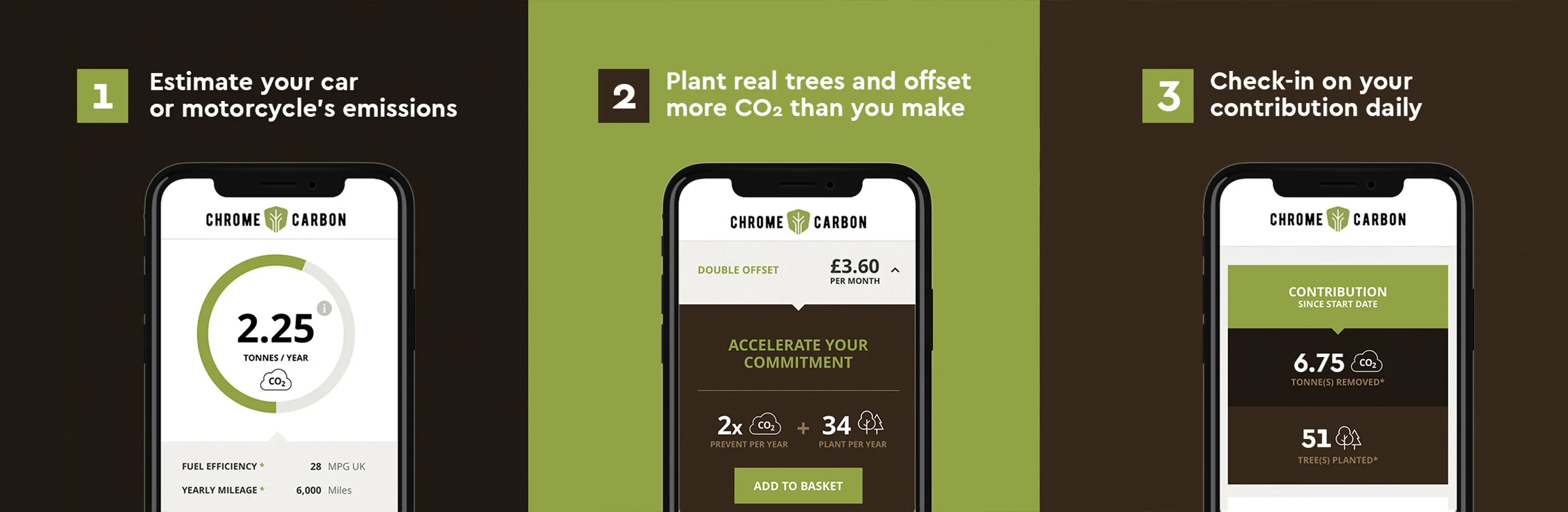
ChromeCarbon gives you an estimate of how much your vehicle is polluting and follows up by providing a solution to that. Using an online tool, you find out the amount of CO2 your vehicle emits (in tonnes every year). And then accordingly you can offset your yearly emissions by subscribing to ChromeCarbon’s monthly plans.
The said monthly plans not just offset your CO2 consumption but also help in extending your contribution towards restoring nature by planting more trees. If you compare the packages, the prices seem to be highest in the UK (owing to the higher cost of acquiring land and logistics) but the difference isn’t huge. And the programme is available for both individuals and businesses. So, if you run a fleet of vehicles and want to do something in the interest of mother nature, this is a great solution — and it won’t look bad on your company’s profile, too.
With the stricter EU restrictions in place (that all manufacturers need to have a fleet average of around 95 g/km of CO2 emissions — 92 g/km for brands with more small cars and 102 g/km for carmakers with larger, heavier offerings), the market dynamics will change dramatically. For instance, according to an Autocar report from earlier this year, for the existing vehicles on sale in the UK, nearly 200 models had their line-ups rejigged. That’s done to bring down the fleet CO2 average — all carmakers now want to get more hybrids and lower-emission vehicles. And they may even limit the number of currently successful vehicles that despite being more lucrative (for the brand) might end up increasing the fleet’s CO2 average. The failure to meet the fleet average won’t just come in the form of a huge fine to carmakers, it can massively increase the cost of buying a new car, too.
So what’s the best way to enjoy motoring without harming the environment?
The solutions aren’t quite straight-forward at the moment. Those looking at driving only for enjoyment and otherwise depending largely on public transport won’t need to worry much. But if the car you have is also your primary mode of transport, then this is certainly serious. If you are looking at helping the environment stay green, ChromeCarbon makes a solid case for itself. And thankfully you don’t even have to buy a new EV to make the change. Check them out (you can find the link below), and please share your experience with us.
Link: ChromeCarbon